It Has Already BegunAnd Most Americans Are Guarding The Wrong Door
🔒 SECURE CHECKOUT VIA GUMROAD · VISA · MASTERCARD · PAYPAL · APPLE PAY
Almost every dollar spent on home defense is aimed at the threat that comes last.
Here's the part nobody selling home security will tell you, because there's no product in it: he knocks first. He has a story ready — looking for somebody who used to live here, tree work down the street. It doesn't have to be good. It only has to survive one confused homeowner.
Answer, and he apologizes and walks. Don't answer, and he's learned the thing worth money to him. The house is empty. The clock starts. Then he runs a checklist in about the time it takes to tie a boot — the dog, the neighbors' sightline, whether that door gives when he leans on it.
He isn't picking the weakest house on the street. He's picking the fastest one. And what kills the plan is knowing somebody's home — a shouted "just a minute" through a door you never open does the identical job. It costs nothing, which is exactly why it isn't in anybody's catalogue.
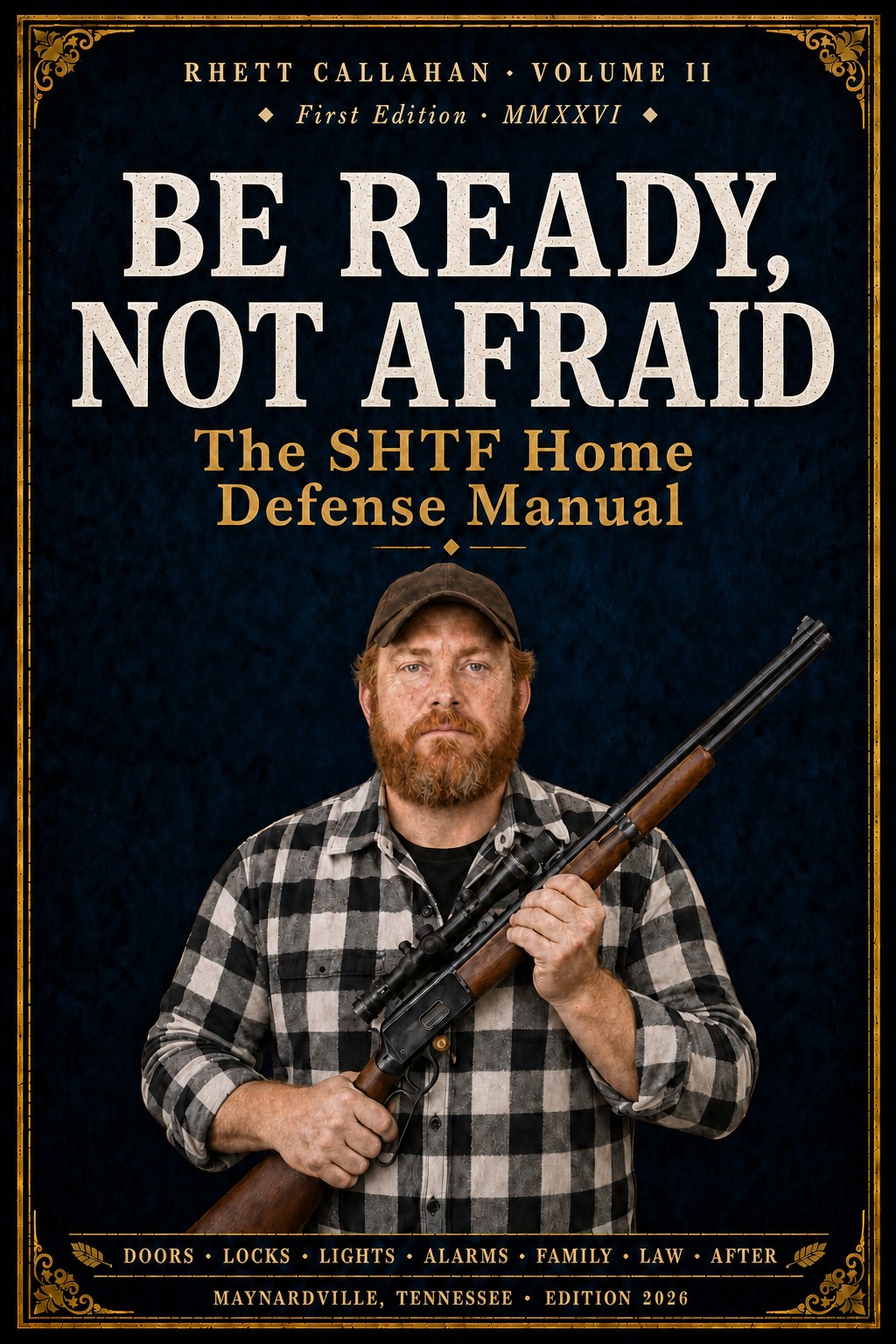
667 pages on defending an ordinary house — the cheap layer first, the expensive layer only where it earns it.
Every chapter tells you which threat level it's for, what it costs, and what it will not do.
667 pages. 97 chapters across eighteen sections, plus three tear-out appendices. Every one sorted by threat level, with the numbers in it. Including:
- What actually happens to American homes — the numbers nobody selling you a bunker wants to lead with · p. 23
- The fear industry — how they sell you a bunker you don't need, and how to spot the pitch · p. 29
- Who actually breaks in, and why — real criminal psychology, not television · p. 42
- The grey home — why you never, ever want to be the interesting house on the street · p. 60
- The front door — roughly a third of them come straight through it, and the reinforcement costs less than a night out · p. 113
- Locks: what actually matters and what is purely marketing · p. 127
- The garage door — the biggest hole in most houses, and nobody mentions it · p. 151
- Signs, stickers, and theater — what deters and what is placebo · p. 185
- The dog question — honest about man's best alarm · p. 192
- The neighbor network — the free security system nobody installs · p. 199
- Cameras: real deterrent or expensive doorbell? Where your money actually goes · p. 226
- Locked down or ready — the hardest trade in a house with kids, argued honestly both ways · p. 282
- Warning shots and other myths that get people killed or jailed · p. 379
- The four questions of lawful force — and what "reasonable" means when a jury decides it · p. 393
- What to say, and what to never say, when police arrive · p. 413
- Stop the bleed — tourniquets and the MARCH order, for the minutes before an ambulance · p. 469
And that's a fraction of it — 97 chapters, from the walk around your own property to the first phone call after.
Every piece of advice in here gets sorted into one of three levels, and that sorting is the whole trick. Everyday — what actually happens, to actual houses, this year. Breakdown — the storm week, the outage, the stretch where nobody's coming. Worst case — the one they sell you first, and I put last.
Sort your money that way and most of it moves. The gear that looked essential belongs to a level you'll likely never meet. The boring fix you skipped sits on the level you're standing in right now.
The rest is the walk. Your ground, your approach, your doors, your locks, your lights. Then the plan, then the law, then the two seconds after — in that order, because that's the order it happens in.
The SHTF Home Defense Manual
First Edition · Instant Download
- The full 667-page Manual — 97 chapters across eighteen sections
- The Home Security Audit Worksheet — walk your property the way a burglar reads it
- The Family Emergency Plan — rally points, safe words, the plan in two sentences
- The Trauma Kit Checklist + Stop-The-Bleed Card — print it, put it in the kit
- Every future edition free — you own every correction that follows
Launch price — ends Sunday night
GET THE MANUAL · $47Emailed to you within 60 secondsThe 7-day, every-dollar guarantee. Read it. Walk your property with Appendix A. And if it isn't what you hoped, reply to your receipt email within seven days and every dollar comes back — no questions, no forms. The Manual stays on your shelf either way. Checkout and refunds both run on Gumroad's rails, same as the receipts.

I run projects at a custom rifle shop in Knoxville, and I grew up shooting on my granddad Earl's land in the Cumberland Foothills, east of Knoxville, if you know the country. Weekend hunter, weeknight reloader, lifelong collector.
I never wore the uniform and I was never a cop — and I'll tell you straight, the men who did know things I don't. What I've got is an engineer's stubbornness about numbers and a low tolerance for being sold fear at a markup. That's why this book spends more pages on your garage door than on the worst case.